Design for Deflection
Group of 2 followed by 4 : 1.5 months
Background
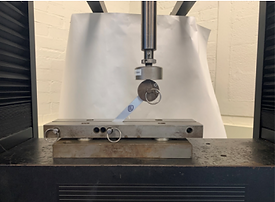
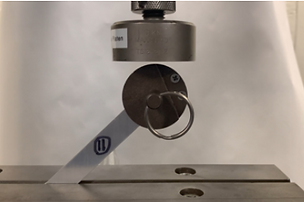
The objective of this project is was to learn how to apply analytical and numerical techniques to design an aluminum structure. The structure deflected linear elastically to a desired deflection under given applied load and boundary constraints. We first worked in pairs to model a C-shaped beam and used Castigliano's theorem and SolidWorks Simulation. Pairs were then grouped to form a team of 4, tasked with designing a structure that deflected .5" under a 200 lbf loading condition. The piece was cut and tested using an Instron testing device.
This was one the project in which I made the most mistakes, but as a result, is one in which I have learned the most. When modeling a structure, the class was asked to also take into account the weight. The more your part weighed, the more points were taken off. The first phase of the project had showed us the power of a C-shaped beam, but it was a heavy piece. I had begun playing with an angled L-shape and ran a simulation to test it out. After everyone else in the team had tested different shapes, we agreed on going in a different direction Aand moving away from the C-shape entirely. We had each calculated the deflection and gotten similar values. At this point, a family emergency occurred and I had to fly back home for a few weeks. With less time to machine the piece and heightened stress, we used the most recent structure we had designed, which had agreeing simulation values and calculations. The in-person results, however, were not at all in the ball-park. It had yielded!

Future Work
I was so focused on areas where points could be lost that I had lost focus on the main goal of the project: to design a structure that yielded .5". It would have been a wise decision to stick to the tried and true C-shape structure, removing material to decrease weight and adding fillets. Simulations are a great method to check calculations, but unless you are certain that the conditions you have set are accurate, it should not be the ultimate decider. Aside from only testing the final 200 lbf, we had applied the force incorrectly.
Sim